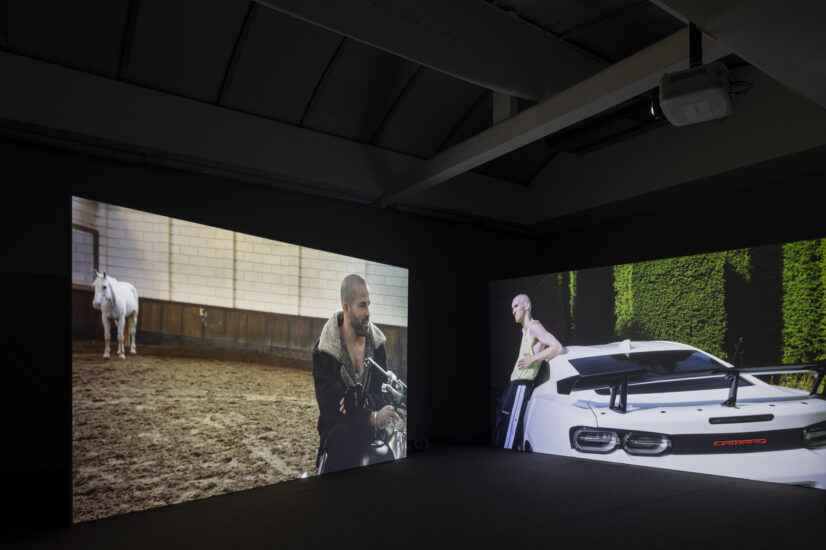
Surfaces and façades are planes of projection and means of representation, but they are also social constructs. We recognize them in bodies, architecture, and objects such as cars: visible layers through which we relate to the world. Norms, social codes, patterns of behavior, and political convictions function as invisible façades behind which people position themselves, seek protection, or derive authority.


Now that we are constantly viewed through a lens, these surfaces seem to become ever more convex, fuller, and smoother. Faces, bodies, and status symbols appear inflated and hyperreal, at times almost more three-dimensional than the human being itself. These physical and social surfaces not only shape how power is made visible, but also how it remains concealed, acting as boundaries between the intimate and the outside world. They inform our perception of power, masculinity, and identity. And as everything increasingly asserts itself on the surface, one question becomes unavoidable: what remains of the inner self?


Taking the exhibition The Seamless Real as its point of departure, Julian Ross and Julika Rudelius engage in a conversation about how Rudelius explores physical and social surfaces as carriers of ideas about power, identity, and representation.

Bio

Julika Rudelius (1968, Germany) studied at the Gerrit Rietveld Academie, followed by a residency at the Rijksakademie van Beeldende Kunsten. Her work has been presented in solo exhibitions at the Weserburg Museum für moderne Kunst, Villa Merkel, Schirn Kunsthalle Frankfurt, Kunstverein München, Kunsthaus Bregenz, Grazer Kunstverein, Frans Hals Museum and Stedelijk Museum Bureau Amsterdam.

It has also been shown at the Centre Pompidou, Tate Modern, New Museum, MoMA PS1, Swiss Institute, Fondation Beyeler, ZKM | Center for Art and Media, Haus der Kulturen der Welt and the Stedelijk Museum Amsterdam. This year, her work will be on view at MUDAM Luxembourg and the Mercedes-Benz Art Collection. She lives and works in Amsterdam and Cologne.


Julian Ross is Head of Film Programming, Distribution & Exhibitions at Eye Filmmuseum in Amsterdam. He was previously programmer at Doc Fortnight at The Museum of Modern Art (2023-24), Villa Medici Film Festival (2024), the Flaherty Seminar (2024), International Film Festival Rotterdam (2015-22), and Locarno Film Festival (2019-20). His film programming and curatorial work has also been presented at Tate Modern, Art Institute of Chicago, e-flux Video & Film, Kunsthal Rotterdam, and Tokyo Photographic Art Museum. He was an Assistant Professor at Leiden University Centre for the Arts in Society and holds a PhD on 1960s Japanese expanded cinema at the University of Leeds.