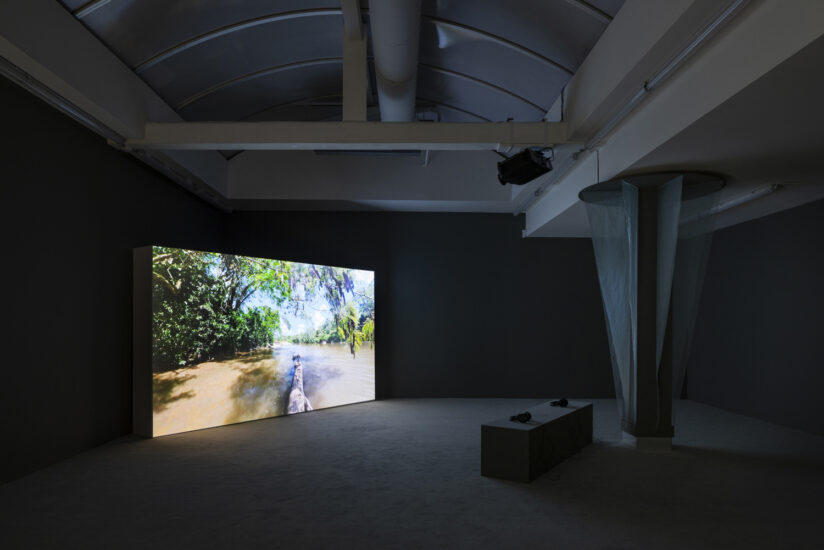
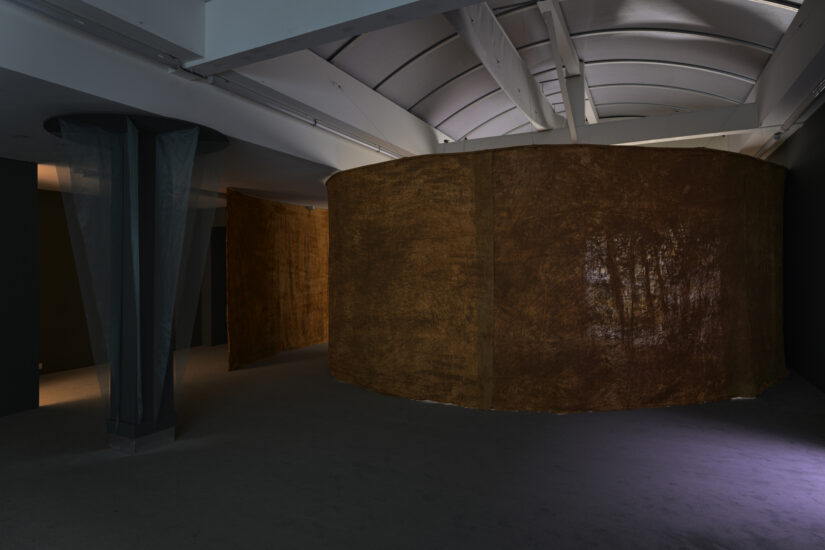
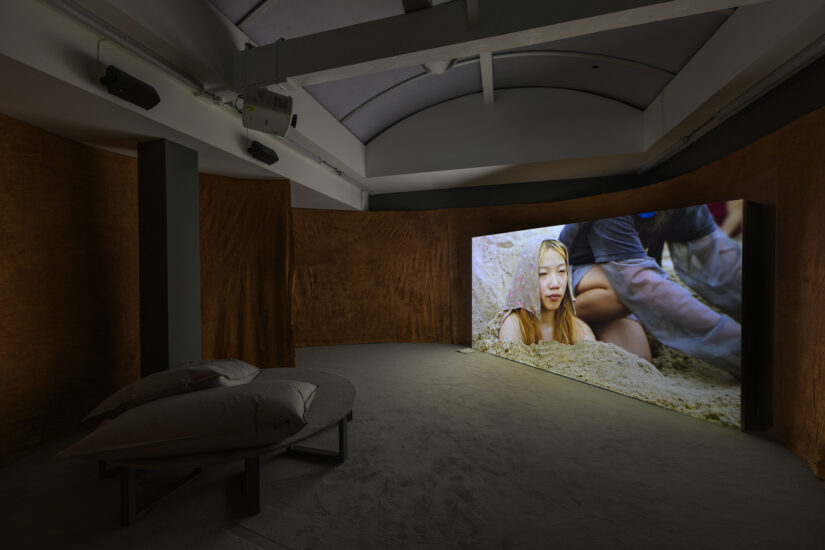
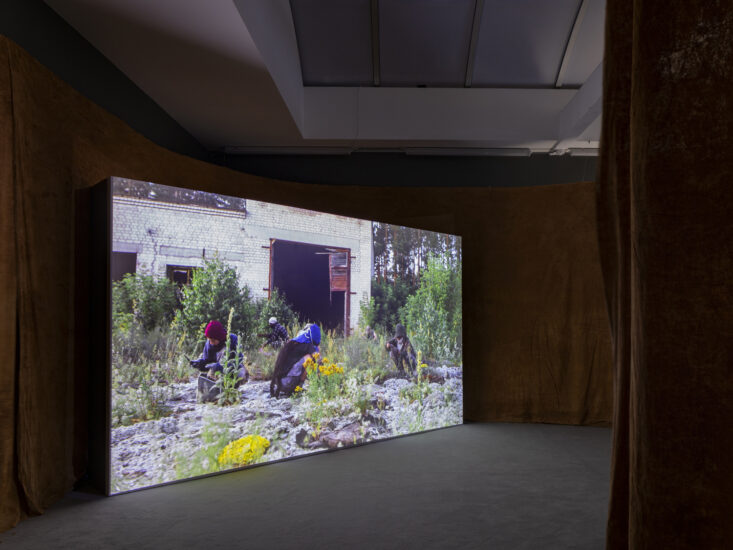
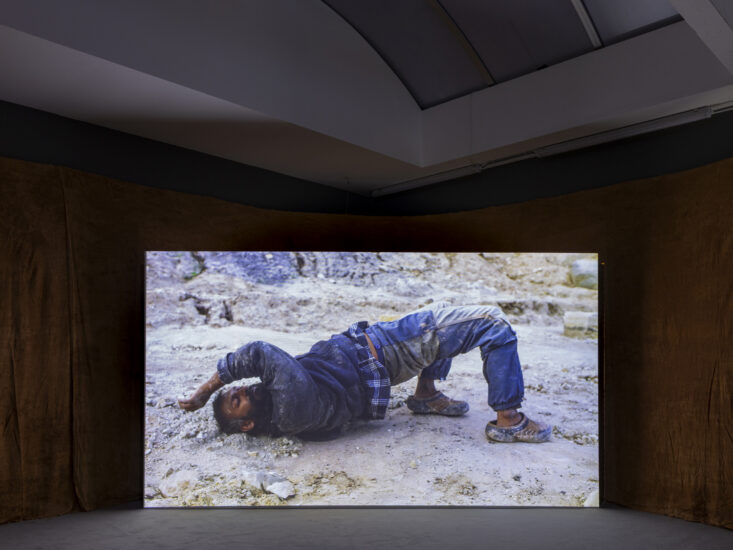
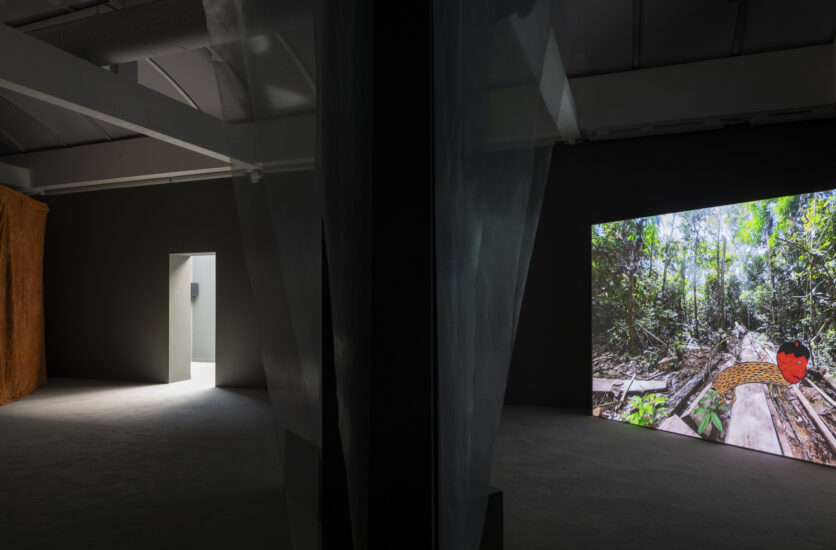
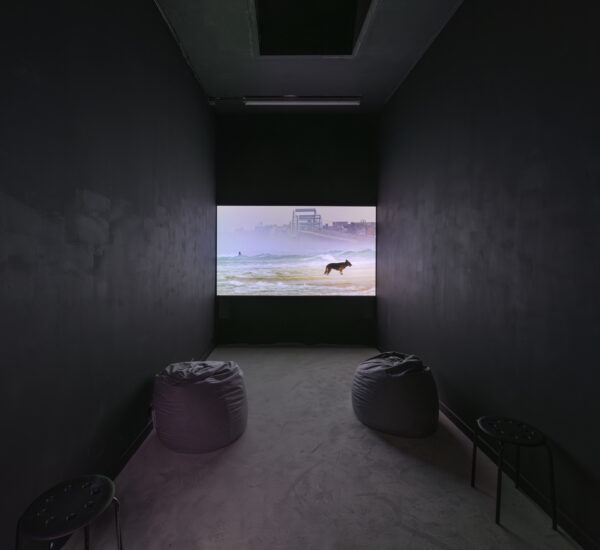
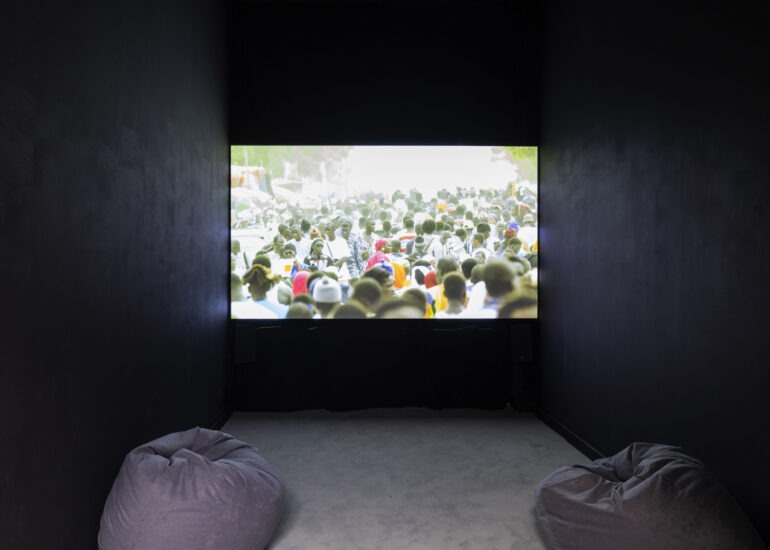
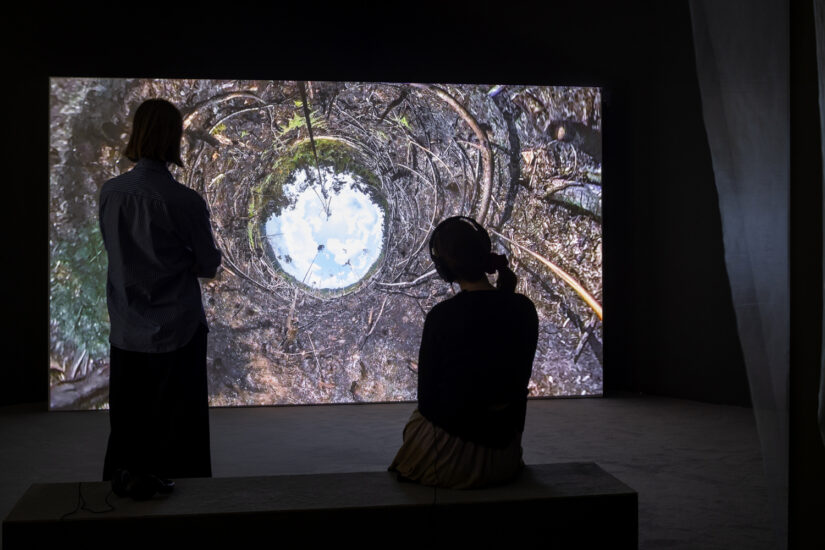
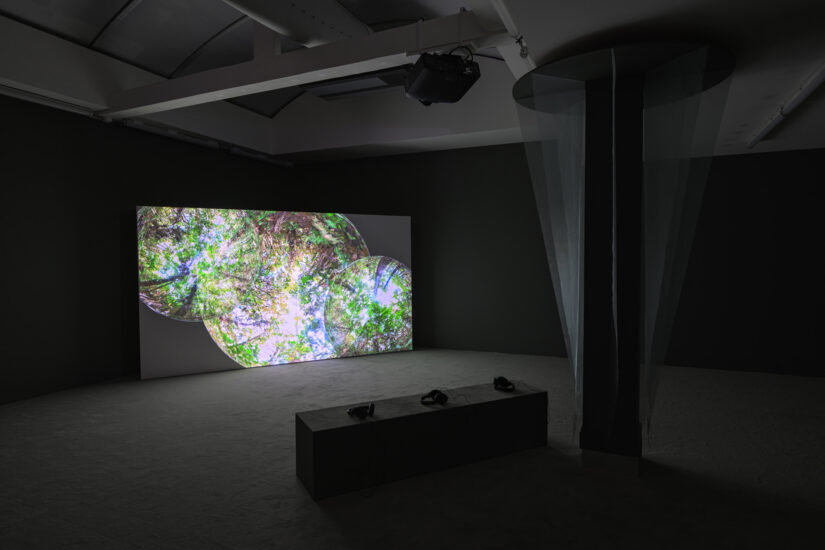
The exhibition Melted for Love, taking place across W139, Arti et Amicitiae, and Rozenstraat, as part of the Sonic Acts Biennial 2026, explores how the notion of ‘home’ is being renegotiated by climate crisis, colonial histories, and forced displacement. The exhibition brings together installations, films, sound works, and performances that reflect on how land, bodies, and ecosystems are shaped and altered by systems of exploitation. By listening to the echoes left behind, it highlights gestures of love and connection with land and community as forms of resistance and repair.
At Rozensstraat we focus on different forms of grief. How do we grieve or memorialise violence that is still ongoing? How do dispersed communities maintain ancestral knowledge while collectivising to seek justice? These questions unfold through a series of moving images and movement-based works that attend to loss as something ongoing and resistant to closure.
Eglė Budvytytė gathers communities around death-care, as they prepare to become part of the soil and air. Eliana Otta collaborates with non-human species in the Peruvian Amazon to imagine sounds that remain after Indigenous land defenders have been murdered. Christian Nyampeta and Kivu Ruhorahoza offer a poetic tribute to the un/dead, reflecting on bonds that extend beyond a single lifetime. Nikolay Karabinovych overlays the map of Amsterdam with an echo of Odessa, constructing a ghost geography shaped by hidden transmissions and generational movement.
This exhibition forms one chapter of Melted for Love, a three-part exhibition programme across Amsterdam. Visitors can purchase a single ticket for each exhibition venue or choose a combined ticket that grants access to all three locations – W139, Arti et Amicitiae, and ROZENSTRAAT. The tickets are not dated, and visitors can use them during general visiting hours, excluding the performance events.
All exhibition spaces are open Wednesday to Sunday, 12:00–20:00. Additionally, the exhibition will also be open on Monday, 2 March, from 12:00 to 17:00.
The exhibition will open on Sunday February 8 with the live performance Search Sweet Country by Christian Nyampeta – a lyrical rendition of songs of love, loss, and overcoming.
Image: Christian Nyampeta
About the artist
Eglė Budvytytė is an artist working at the intersection between visual and performing arts. She approaches movement and gesture as technologies for subverting gender norms, social roles, and the narratives that shape public space. Her practice – spanning song, poetry, video and performance – explores the persuasive power of collectivity and the permeable relationships between bodies, audiences, and their environments.
Budvytytė’s work has been shown at the 59th Venice Biennale, Frac Île-de-France, Nam June Paik Art Center, Vleeshal, Canal Projects, the Renaissance Society, the Stedelijk Museum, De Appel, and the 19th Biennale of Sydney, among many others. She was a resident at Le Pavillon, Palais de Tokyo, and at Wiels Contemporary Art Centre. In 2026, she will represent Lithuania at the 60th Venice Biennale.
Eliana Otta explores collective mourning as a decolonial and regenerative practice. Through a process she describes as ‘fertilising mourning’, she examines how shared grief can dismantle hierarchical binaries, such as life and death. Opening up spaces for intimacy, trust, and curiosity, her practice often merges pedagogical, curatorial, and editorial approaches.
Otta holds a master’s degree in Cultural Studies and completed a PhD at the Academy of Fine Arts in Vienna. She is the co-founder of the artist collective Bisagra in Lima and the ecofeminist group Mouries in Athens, and was part of the curatorial team for the permanent exhibition at Lugar de la Memoria, la Tolerancia y la Inclusión Social in Lima. She has been an artist-in-residence at Gapado AiR, Capacete, and the Sommerakademie im Zentrum Paul Klee, among others.
Christian Nyampeta is an artist, filmmaker, and organiser whose exhibitions, screenings, gatherings, and publications function as hosting structures for collective feeling, cooperative thinking, and mutual action. A central thread in his practice is the question – and affirmation – of ‘how to live together’, a phrase drawn from Roland Barthes.
As a filmmaker, he takes a poetic and relational approach, treating moving image as a site for shared learning and social encounter. His video installation When Rain Clouds Gather was commissioned by Fondazione In Between Art Film on the occasion of the Venice Biennale 2024. From 2022 to 2024, Nyampeta organised Boda Boda Lounge, a trans-African film and video art festival. He has contributed to the 14th Shanghai Biennale, the 58th Carnegie International, Manifesta 14, and the 17th Istanbul Biennial. In 2019, he received the European Union Prize at the 12th Bamako Encounters. In New York, he facilitates the African Film Institute at e-flux and serves on the boards of Storefront for Art and Architecture, Blank Forms, and November Magazine.
Kivu Ruhorahoza is a filmmaker, screenwriter, and producer who has emerged as a distinctive voice in contemporary African cinema. His debut feature Grey Matter (2011) – which explores societal rupture and trauma in post-genocide Rwanda – premiered at the Tribeca Film Festival, where it received a Jury Special Mention for Best Emerging Filmmaker and won the festival’s Best Actor award. The film later received further recognition, including Best Director and the SIGNIS Award at the Córdoba African Film Festival, the Jury Prize at the Khouribga African Film Festival, and the Grand Prize at the Tübingen French Film Festival.
Other standout work includes Things of the Aimless Wanderer (2015), which premiered at Sundance and interrogates the fraught dynamics between ‘locals’ and Westerners in East Africa; and Father’s Day (2022), which debuted in the Encounters section of the Berlin International Film Festival and interweaves three narratives on fatherhood, grief, and the intimate consequences of historical violence.
Ruhorahoza has been exhibited internationally, including at Tate Modern, the Institute of Contemporary Arts (ICA), and the Museum of Modern Art (MoMA). His short films have won several honours, such as the City of Venice Prize at the Milan African, Asian and Latin American Film Festival, Best African Short, as well as awards at the Montréal Vues d’Afrique Festival.
Nikolay Karabinovych works across video installation, performance, sound, and sculpture. His practice addresses layered social histories – particularly those shaped by the cultural and political landscapes of Eastern Europe – interwoven with personal family narratives. Questioning identity, belonging, and exclusion, he frequently turns to music, revisiting epochal songs, genres, and figures for their ability to refract past eras through the lens of the present.
Karabinovych served as assistant curator of the 5th Odesa Biennale. He received the PinchukArtCentre Prize in 2022, 2020, and 2018. His work has been widely exhibited at institutions including HKW, Museum van Hedendaagse Kunst Antwerpen, Museum de Fundatie, MAXXI, the Albertinum, Staatliche Kunstsammlungen Dresden, the Belgium Jewish Museum, Bozar, W139, and Zamek Ujazdowski, among others. He has also participated in Steirischer Herbst 2024, the Kaunas Biennale 2023, the Kyiv Biennale 2023 and 2021, Survival Kit 2023, and the parallel programmes of the Venice Biennale 2022 and 2024.
Images: Peter Kers. Beeld.nu