On Sunday, April 12th, from 4–6 pm, Rozenstraat hosts a screening of two recent film works by Rumiko Hagiwara and Zachary Formwalt, followed by a Q&A with the artists.
Both films express, in different ways, the absurdity of trying to grasp the vast, seemingly incomprehensible forces shaping our world, from an individual vantage point. As is often the case these days, the smartphone appears in these works as a key technical object through which the individual is synchronised, and ultimately metabolised. While this device concretely renders our place within these present-day processes, the films turn to earlier, historical mechanisms. In Hagiwara’s View of Dejima, it is the Japanese folding hand fan, and its circulation as a gendered and racialising screen in nineteenth-century paintings produced in the West, that serves as a historical prototype for the deracination at the heart of smartphone production and use. In Formwalt’s Scenes from a film called ‘capture’ it is Etienne-Jules Marey’s myograph—an instrument developed in the nineteenth century to measure the reaction of muscles to electric shocks—that becomes a model for the extraction of energy and attention underpinning today’s technical objects.
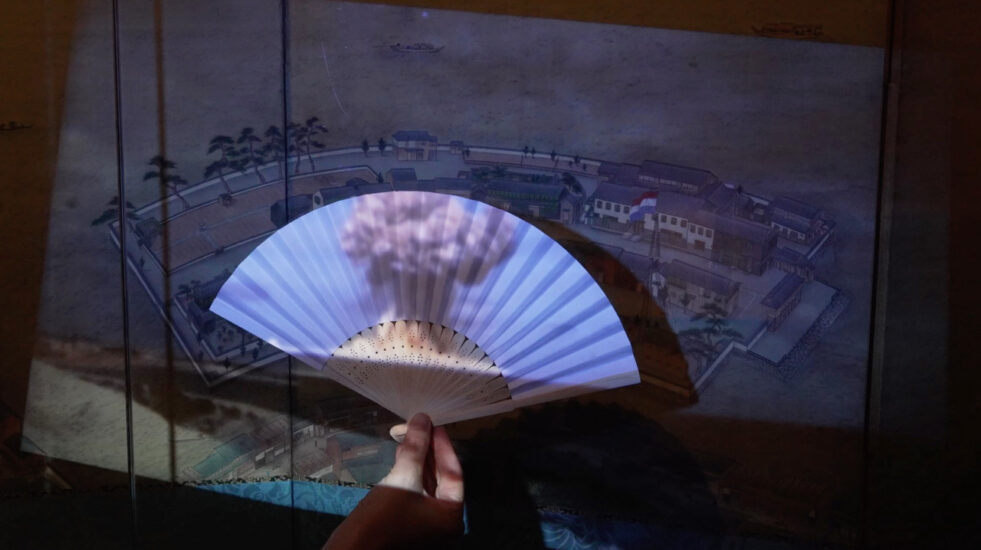
View of Dejima (2025, 20″)
A Japanese woman stands in front of the 19th-century folding screen “View of Dejima in Nagasaki Bay” at the National Museum of Ethnology in Leiden. She is captivated by the image of Dejima — the Dutch East India Company’s trading post and Japan’s only gateway to the West for over two centuries — which takes the shape of a folding fan. What if that “gate” to the West had remained closed? How might Japan’s culture and economy have evolved, and what would it mean for her, a Japanese woman living in the Netherlands?
Scenes from a film called “capture” (2025, 23″)
From left to right, a barge full of waste crosses the screen. From bottom to top, waves gather — traces, perhaps, of a wasted body. A ship is burning in the Port of Amsterdam as fingers tap screens to tell friends: “It smells like burnt toast.”
“On the other hand,” someone reads in a newly translated classic, “it disrupts the metabolizing that goes on between human beings and the earth,” and wonders what “it” is — and how they might see it. Scenes from a film called “capture” moves through industrial ports, 19th-century physiological experiments, and digital interfaces in search of sites where movement and metabolism have become forms through which life and labor are abstracted into data and value.
Image: Rumiko Hagiwara, View of Deijma (2025). Film still.