For eromheen (being around), Kinke Kooi transforms the space of ROZENSTRAAT – a rose is a rose is a rose into a total installation in which new and existing works come together. ‘Eromheen’ is a concept of her own, whose significance Kooi seeks to emphasize. She describes it as ‘a vase around water, a climbing plant around a tree, decoration around a door, a supporter around a star, a setting around a stone, a womb around a baby, and a wall around a room’. Kooi’s work is explicitly antipatriarchal and advocates the feminine in human beings. Through her refined drawings and painted photographs, with their fluid lines, curves, openings and brightly colored rays, she explores themes such as shame, sensuality, domesticity and ‘hospitality’. She approaches ‘the other’ with gentleness and compassion, directing our attention towards what generally goes unnoticed, what we prefer not to show, and what we feel ashamed of. She regards this attention as a political statement. Her work exposes the norms and expectations that determine what is allowed to be visible, what must remain hidden and what is considered valuable.
One of the earliest works in which she explores the concept of eromheen is the diptych Fat Butt, Greasy Sausage (1991). It emerged from a personal exploration of shame, but also from a fascination with mass, matter and volume. The fleshy, bodily forms, full and heavy, were not only the subject of the work but also reappeared in the background, in the supporting, subordinate space surrounding the central image.
A similar bulging, voluminous form marks the word ‘Mother’ in Moeder (2003). Here, the subject becomes visible precisely through the cut-out, the void or the hole created by the forms Kooi draws around it. The nearby works Bleeding mother heart and Menstruating woman (both 1992) further develop the concept of ‘motherhood’. Together, the works connect two representations of the female body: that of a bleeding, suffering Virgin Mary and that of a menstruating woman. In Bleeding mother heart, the wound also refers to the side wound of Christ, which in Christian iconography is sometimes depicted as an almond-shaped opening resembling a vulva. The artist thus draws a parallel between the religious representation of Christ’s wound and the everyday, bodily experience of menstruation. She suggests that female anatomy and menstruation may themselves have been at the origin of this religious visual language. By, as it were, reclaiming this imagery, she appropriates a religious symbol and gives it a female, bodily origin.
In later works, the bulging forms turn inwards, giving way to openings and cavities. This lends the body a different spatial dimension. What once protruded outwards as a mass now becomes introverted. Kooi maintains that these forms stem from an ‘innate aesthetic’. The cavities and openings are often accompanied by floral motifs, for which she also has a great affinity. This can be seen, among other works, in Hospitality (2025), Support (2022), Preventing the sharp from being sharp (2025) and Support (2026), which frequently feature a twisting, climbing bean plant. With its soft, velvety interior, the bean is an embodiment of enclosure and a bearer of fertility: a protector of the tactile, spherical seeds contained within it. The surrounding fleshy forms protect, ward off and, at the same time, evade whatever seeks to penetrate from the outside.
Her interest in the non-static, the folded and the fleshy emerges in several works. Why are we afraid of the formless, and why do we place construction above it? Kooi asked herself this question while making Principle of Motion (2023), in which a naked man wrestles with a soft cloth. The work brings together two seemingly opposing forces: the desire to impose form and control, and the resistance of that which is mobile and mutable. It also echoes a critique of patriarchal thinking, in which control, order and measurability have traditionally been associated with the masculine, while the organic, changeable and elusive are labelled feminine and often dismissed as inferior.
Her most recent work, Pink Daffodil (2026), addresses another theme that preoccupies Kooi, which she calls ‘visual loneliness’. For a long time, she yearned for images in which she could recognize herself but found none. She therefore decided to create images of her own that did justice to her lived experience. In this work, she uses the flower as a metaphor for the loneliness that can arise when you do not see yourself reflected in the dominant visual culture. Whereas most daffodils are yellow, the pink variety presents an image that deviates from the norm. The flower thus embodies the need for recognition and representation of experiences and perspectives that fall outside the mainstream.
In Digging for Origin (2013), too, she gives form to a desire that runs counter to the dominant current. In contrast to the impulse to move upwards, build and rise, she proposes an inward, downward movement: a search that leads not upwards, but towards the origin.
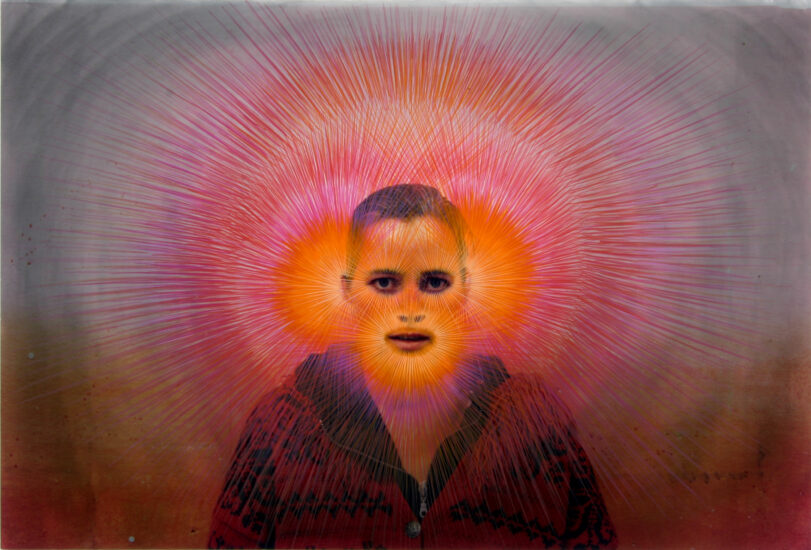
The space of eromheen is also expressed in her so-called ‘aura works’, five of which are presented in this exhibition: Sunny Day, Happy Moment (199), Fool (1998), Smell fan (1995) and Sunny Day, Happy Moment (1997). Rather than directing the gaze towards a central point, the lines in these works make the surrounding space tangible. They evoke what is also part of us but lies beyond our
immediate field of vision, such as warmth and scent. Our bodies do not end at their visible contours, but extend into the space around them. Smell fan emerged from Kooi’s astonishment at the social norms surrounding body hair: why were women expected to shave their pubic and underarm hair, while men were not? Female sexuality was thereby, as it were, stripped of its bodily particularity. She decided not merely to question this inequality, but to turn the experience into an image.
Kooi shows that beauty and strength reside precisely in what we so often overlook. In doing so, she challenges our ideas about beauty and social status. Why is one thing considered important while another is relegated to a subordinate position? And why is the aesthetics of the feminine so often undervalued?
In eromheen, the boundaries between inside and outside, body and environment begin to dissolve. A sense of interconnectedness emerges, in which nothing exists in isolation, but everything exists in relation to something else. The installation itself reflects this idea. The numerous sightlines, small objects and trinkets, sensory qualities and associative dialogues between the works create an environment without a central focal point. Visitors are invited not only to look at the individual works, but also to pay attention to what unfolds in between and around them.
eromheen has been made possible through the support of the Mondriaan Fund and the Amsterdam Fund for the Arts, and through loans from Stedelijk Museum Schiedam, AkzoNobel, and Centraal Museum Utrecht.
Image: Kinke Kooi, Fool, 1998, acrylic on photo
Support